portfolio

Additional Works
This blog will unpack how costume, make-up, and set design in Dracula and Frankenstein enhance narrative elements and establish the stars as cultural icons, reflecting Hollywood’s dual role as both a storyteller and a dream-maker.
-
Hollywood's “Golden Age” was the era of the most iconic cinematic monsters: Dracula and Frankenstein. These iconic characters represent Gothic literature and are widely known as symbols of the horror franchise while simultaneously embodying the idea of Hollywood’s Dream Factory. Bierstedt's review of this “Dream Factory” examines “the conflict between business and art in Hollywood [as] a reflection of the conflict within our culture.”(5) Universal Pictures' Dracula (1931) and Frankenstein (1931) display an innovative and unique style with impactful star performances. This horror trope that was produced during the Depression era, was able to create fantastical worlds, through elements of production design. These films articulate and further mirror the societal and cultural context of their creation era. This blog will unpack how costume, make-up, and set design in Dracula and Frankenstein enhance narrative elements and establish the stars as cultural icons, reflecting Hollywood’s dual role as both a storyteller and a dream-maker.
F.W. Murnau's Nosferatu (1922) profoundly impacted the aesthetics and thematic development of later horror classics, including Dracula (1931) and Frankenstein (1931). Nosferatu's innovative use of visual elements, including chiaroscuro lighting, heightened the dread and otherworldly feeling. “Murnau weaves formal elements into the narrative that disrupt the viewer’s expectations and leaves only questions and anxiety in his wake. [...]To quote the filmmaker himself, “I like the reality of things, but not without fantasy; they must dovetail.”” (East 8-9) Count Orlok's construction in Nosferatu paved the way for the creation of the monster, “through the creative, yet subtle make-up on actor Max Schrek, we see that the figure is grotesque” (East 4). Both Dracula and Frankenstein inherited from Nosferatu the blurring of the lines between humanity and the monstrous and the exploration of the boundaries between life and death. Nosferatu's silent, expressionistic approach to horror served as a template for the atmospheric filmmaking in both films, where the visual portrayal of the supernatural played an essential role in conveying the otherworldly nature of their central figures.
-
Censorship shaped content, studios such as Universal were trying to satisfy the commercial imperatives of the studio while having some cultural commentary. The term "Dream Factory" describes Hollywood's capacity to create fantastical worlds that use lavish spectacle to pull viewers away from their harsh realities (Young). The alternative and imaginative world created by the horror and fantasy films of the Depression era offered viewers an escape from reality. The set design, makeup, and costume developed the narrative and produced dreamscapes. Ellie Slee states that, “it was escapism that would make Dracula [...]Universal’s most successful film of 1931”(Slee 33). Due to widespread concerns surrounding sexuality, which was a serious threat during the Depression, audiences in the 1930s were searching for an escape. By taking advantage of this anxiety, horror within film controlled the audience (Slee 33). These fears were taken from the original texts and encompassed within the film adaptations. "The books that were immortalized on-screen – Mary Shelley's Frankenstein (1818) and Bram Stoker's Dracula (1897), for example – [...] is where these societal fears originally surfaced. (Slee 34) Yet, aesthetics serve a crucial role in the development of a narrative while concurrently enriching characters with depth within film. The costumes on display serve to both distinguish the various characters' identities and the transformations that occur.
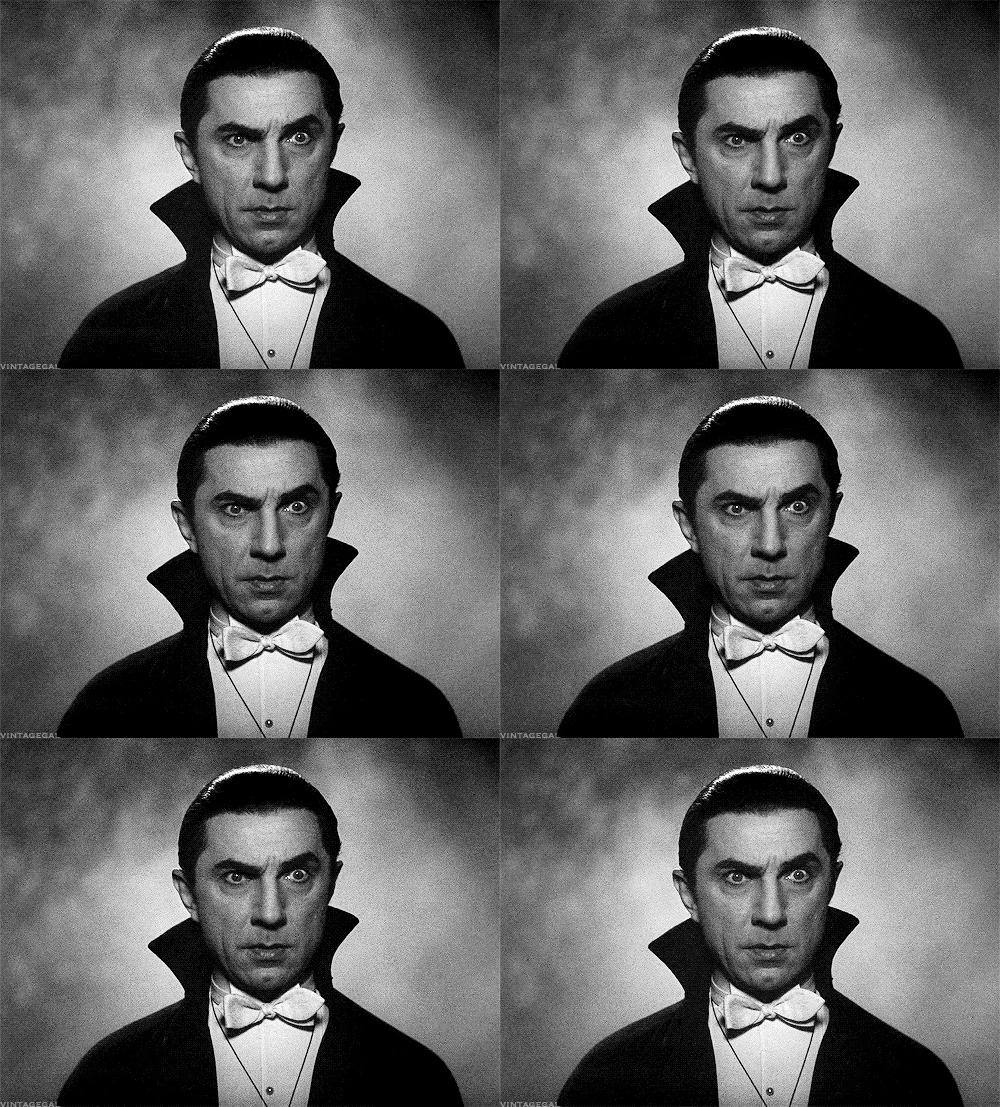
The use of costume in Tod Browning’s 1930 adaptation of Dracula highlights how aesthetics can further enrich characters with depth.“Lugosi’s Count was an elegant, seductive foreign aristocrat instead of Stoker’s repulsive and physically very distinctive-looking vampire”( Saarenvesi 23). When an actor adopts an iconic role such as Dracula the audience has difficulty separating the character from his public persona, “therefore stars usually become known for the roles with which the audience finds it easy to identify ”(Hakola 79).
The distinctive and encapsulating makeup highlighting his pale face and dark hair makes his character more inseparable. The acting simultaneously works with the make- up in a manner which leaves an unnerving impression on the audience with Lugosi’s intense gaze and monstrous nature. Lugosi’s sharp tailored suit encompasses his aristocratic nature yet we are aware of the underlying constructed monster that represents broader themes of corruption and disorder. “Tod Browning’s 1931 production is undoubtedly the most famous in the litany of Dracula adaptations, and its star, Bela Lugosi, the most memorable and influential of Dracula personages” (Wishingrad 53). Lugosi’s portrayal elevated his publicity as an actor and ultimately transformed him into a star. There is constriction within this stardom as Lugosi was unavoidably typecasted similar to Boris Karloff, “on the one hand they became stars because they fitted these monster role expectations and on the other hand the generic expectations moulded their stardom enormously” (Hakola 79).
-
While the role of Dracula's brides is beneath that of Dracula, their garments emphasise their alluring and otherworldly qualities. Their costumes feature aspects that accentuate the themes of sexual attraction and the blurring between human and demonic characteristics. “Everything about Dracula’s wives reflects this new, subcultural movement – a conscious fetishization of Medieval dress, [...] with their long, centrally parted flowing hair and their velvet, liquid-like gowns” (Slee 35).
The bride's gowns contrast dramatically with Dracula's gloomy, ominous tones. The use of translucent textiles and trailing silhouettes give them an almost ghostly aspect, emphasising their existence outside the realm of the living, trapped between life and death. Furthermore, their costumes emphasise their dual roles as objects of desire and agents of vampire seduction. The use of flowing fabric enhances their sexuality, particularly during the scene where they interact with Renfield, portrayed by Dwight Frye. The brides embody the gothic ideal of beauty in death, blending sensuality and mortality. The outfits visually symbolise the women's dual positions as victims and predators in Dracula's realm, highlighting the film's complex commentary on desire and corruption.
-
Makeup plays an important role in highlighting character portrayals and supporting themes within the narrative. It creates an ethereal quality that draws viewers into a nightmarish world. The concept of anxiety that is at the heart of the novels of Frankenstein and Dracula is reinforced, and the immersive experience of the film is underpinned. Unquestionably, the gothic genre and German Expressionism served as inspiration for both productions. According to some critics, “Boris Karloff succeeded Lugosi” the reason for this may be that “makeup artist Jack Pierce researched subjects relevant to Frankenstein creature makeup, from surgery to “electrodynamics” (Magoun 495).
Boris Karloff was transformed into the iconic Frankenstein by Jack Pierce. Pierce's audacious style transformed many film genres, including the horror niche. The physical characteristics that comprised Frankenstein were highly identifiable. Pierce's makeup was not only dramatically distinct but it "probably remains most people's image of Frankenstein's monster" (Davidson, 235). Pierce creates an extremely complex look by using a range of prosthetics, such as a flat, square-shaped head, distinctive eyebrows, and neck bolts, which highlight the monster's manufactured and unnatural appearance. Karloff is shown as utterly frightening, yet he still has a human aspect within him. By emphasising his somewhat human nature with dark eye circles and unusual complexions, there seems to be some degree of innocence trapped in an inhumane appearance.
Frankenstein's makeup became a distinguishing component of early horror cinema, demonstrating how makeup may enhance character development.Pierce's design not only demonstrated the Monster's otherness but also gave him additional complexity. Alongside Karloff's performance, the makeup elevated the monster beyond superficial level, emphasising Frankenstein as a sorrowful figure who was misunderstood. The imaginative methods combined with the aesthetic elements of makeup demonstrate how makeup can play a crucial role in narrative development, particularly in film.
-
The Bride of Frankenstein (1935), directed by James Whale, builds on the renowned use of makeup in its predecessor, Frankenstein (1931). The most visible continuation of Frankenstein's makeup is the design of the Monster as embodied by Karloff. The Monster's makeup underscores his status as an unnatural being, although in The Bride of Frankenstein, it is subtly modified to make him appear slightly more expressive. For instance, his eyes and mouth appear more open, allowing Karloff to express himself with greater ease than in the first film. This shift in makeup reflects the Monster's increasing emotional depth as he encounters longing and rejection.
The appearance of the Bride of Frankenstein, played by Elsa Lanchester, adds an additional dimension to the overall aesthetic. The Bride's sharp elements contrast starkly with the Monster's rounded appearance. Her white streaked hair and angular face positioned her in a separate category from her husband. Her makeup, which was carried out by Jack Pierce, has a striking, almost alien look that makes her appear human-like and monstrous. Her hairstyle, characterised by lightning bolt-shaped streaks of white, emphasises her status as a visually striking monster figure who transcends the conventional notion of a bride. The makeup in The Bride of Frankenstein continues on the artistic and thematic components of the original Frankenstein, while simultaneously introducing new layers of visual complexity that contribute to the film's investigation of humanity and monstrousness.
-
The city of London and Count Dracula's Transylvanian castle stand in stark contrast in Browning's 1931 adaptation of Dracula. In addition to the supernatural forces of Dracula infiltrating the logical and industrialised world of early 20th-century London, the contrast between the two emphasises the conflict between the old and the contemporary. Darkness and rocky mountains encircle Dracula's castle, which serves as a classic European gothic backdrop. The castle is emphasised as a location beyond the grasp of everyday societal life with no humanity present by the set design, which is dominated by crumbling stone walls and ominous darkness in the film's early scenes. As a manifestation of ancient superstition, Dracula's malevolent and predatory nature is allowed to flourish in this mediaeval castle. This ominous atmosphere is further reinforced by the lighting and deep shadow. Considering this universe is set far removed from reality, Dracula is free to be himself.
The psychological manipulation that is at play in this scene is further underscored by the set design. This demonstrates Dracula's power through both his physical presence and the environment. The lighting is important, employing controlled shadows and bright light to depict Dracula, consequently implying his monstrous traits and fostering an ominous sense of isolation.
The close-ups of Dracula's face, emphasise his predatory tendencies. A sensation of entrapment is created by the set design; this incarceration, when contrasted with the idea of a wider city outside, reflects the psychological imprisonment that Dracula seeks to impose on his victims. Unlike the dark remoteness of the castle, the city offers no immediate refuge from Dracula’s control, underscoring the film’s main subject of the inescapability of evil, even in the midst of a contemporary, civilised society.
-
During the moment in which Frankenstein makes friends with Maria, the viewer is presented with the concept of the tragic nature of the monster. Brightness and a degree of purity to the natural environment are implied by the set design. The beautiful, natural lighting suggests tranquillity and harmony. Maria integrates perfectly into her picturesque surroundings as we watch her play by the water.
Frankenstein's earlier scenes in the oppressive laboratory stand in stark contrast to this new, picturesque landscape. Due to his own isolation, Frankenstein misinterprets other characters, which ultimately results in tragedy. Sadly, if the Monster didn't have a physically grotesque form, the natural greenery suggests a world in which he might reside.The Monster and Maria's interactions are the main emphasis of the scene's final moments, and the set design and camera angles enhance the scene's overall emotional impact and intensity. Boris Karloff's acting and physical gestures accentuate his imposing presence, which contrasts with the vast, picturesque area that envelops him. His physical presence next to Maria, who is playful and sincere, emphasises how otherworldly he is.
Yet the natural lighting in this medium shot, in particular, makes the Monster appear friendlier by highlighting his innocent curiosity and need for friendship. In contrast to the Monster's naive behaviour and playfulness, the dark trees surrounding him hint at the danger he unknowingly possesses.The inner workings of Frankenstein's Monster are encapsulated in the dichotomy between his innocence and potential danger: he is a creature caught between his physical makeup and the misunderstanding of those around him. He is further emphasised as this unusual Monster by the use of light and dark in contrast to the set design.
-
“Bela Lugosi as Dracula.” BAMF Style, Image , 20 Oct. 2023, bamfstyle.com/2023/10/20/dracula-lugosi/. Accessed 12 Dec. 2024.
Brodey, Garrett. “Dracula: One of My Favorite Horror Films.” Brodeysfilmjournal, Image, www.brodeysfilmjournal.com/post/dracula-one-of-my-favorite-horror-films. Accessed 18 Dec. 2024.
BUI, HOAI-TRAN. “A Horror Newbie Watches ‘Frankenstein’ and ‘Bride of Frankenstein’ for the First Time .” Slashfilm, Image, 17 Oct. 2017, www.slashfilm.com/553951/watching-frankenstein-and-bride-of-frankenstein-for-the-first-time/. Accessed 12 Dec. 2024.
Chingy1224. “Dracula Attacks Renfield Scene.” YouTube, Video, 19 Dec. 2013, www.youtube.com/watch?v=ulOT1u3YQzo. Accessed 12 Dec. 2024.
Davidson, Jane P. Golem — Frankenstein — Golem of Your Own. pp. 228–43, www.jstor.org/stable/pdf/43308244.pdf. JSTOR. Accessed 11 Dec. 2024.
“Dracula.” Filmaffinity USA/UK, Image, www.filmaffinity.com/en/film358442.html. Accessed 12 Dec. 2024.
East, Alicia Roxanne. Waking Dreams: F.W. Murnau’s Nosferatu and Weimar Era Cinema. pp. 1–10, kb.osu.edu/server/api/core/bitstreams/41201177-06ef-57e7-8423-da338458b222/content. Accessed 11 Dec. 2024.
Fear: The Home of Horror. “The Monster Meets His Bride | the Bride of Frankenstein (1935).” YouTube, Video, 30 Oct. 2018, www.youtube.com/watch?v=85se1vCri78. Accessed 12 Dec. 2024.
Gwenda Young 16.10.24, UCC Lecture
Hakola, Outi. “On-Screen and Off-Screen Monstrosity of Béla Lugosi and Boris Karloff.” University of Turku, pp. 79–83, iipc.utu.fi/reconsidered/Hakola.pdf Accessed 11 Dec. 2024.
“ Hollywood: The Dream Factory an Anthropologist Looks at the Movie Makers London : Secker & Warburg, 1951.” Hortense Powdermaker, pp. 1–223, thuvienso.net/upload/library/69734/preview/hollywood-the-dream-factory-an-anthropologist-looks-at-the-movie-makers-69734.pdf. thuvienso. Accessed 16 Dec. 2024.
Kend, Will. “Dracula (1931), & Drácula; Film Article #2.” Shadowsinfilm, Image, 11 May 2015, shadowsinfilm.wordpress.com/2015/11/05/dracula-1931-dracula-film-article-2/. Accessed 18 Dec. 2024.
MAGOUN, ALEXANDER B. “Why Frankenstein Became Electric.” IEEE, vol. 107, no. 2, Feb. 2019, pp. 488–98, https://www.researchgate.net/publication/340771644_Why_Frankenstein_Became_Electric#fullTextFileContent Accessed 11 Dec. 2024.
“Marilyn Harris.” Classic Monsters, Image, www.classic-monsters.com/marilyn-harris/. Accessed 12 Dec. 2024
Romeyn. “Dracula’s Brides, 1931.” Fists and .45s!, Image, 5 Oct. 2018, www.paper-dragon.com/fistsand45s/draculas-brides-1931/. Accessed 12 Dec. 2024.
Royle, Lewis. “Nosferatu at 100: The Genesis of Horror.” The Indiependent , Website , 15 Mar. 2022, www.indiependent.co.uk/nosferatu-100-genesis-of-horror/. Accessed 11 Dec. 2024.
Saarenvesi, Riina. “Dracula’s Women: The Representation of Female Characters in a Nineteenth-Century Novel and a Twentieth-Century Film.” UNIVERSITY of JYVÄSKYLÄ, 2004, Accessed 9 Dec. 2024.
Slee, Ellie. “Femininity and Costume in 1930s Horror - Film, Fashion & Consumption.” University of Birmingham, vol. 3, no. 1, 2014, pp. 31–45, www.proquest.com/docview/1646779615?parentSessionId=cVpfIiuidzQA4uhoFr53PfPfUhexDf7Z8WG0MC2BJSk%3D&pq-origsite=360&accountid=14504&sourcetype=Scholarly%20Journals. ProQuest. Accessed 19 Nov. 2024.
Vellum, Manor. “Faces of Frankenstein: The Innovation and Influence of James Whale’s ‘Frankenstein.’” Medium, Image, 3 Feb. 2023, manorvellum.medium.com/faces-of-frankenstein-the-innovation-and-influence-of-james-whales-frankenstein-4888cdb0e475. Accessed 12 Dec. 2024.
Wadsworth, K. “Dracula (1931).” The Movie Crash Course, Image, 22 Feb. 2019, moviecrashcourse.com/2019/02/22/dracula-1931/. Accessed 12 Dec. 2024.
Wishingrad, Emily. Seeing the Vampire in the Cinematic Mirror: An Examination of Three Early 20th Century Film Adaptations of Stoker’s Dracula. May 2016. Accessed 23 Oct. 2024.